LBank received a stern warning from Japan’s financial watchdog for allegedly conducting transactions without proper registration.
Japan’s Financial Services Agency (FSA), according to Coinpost, highlighted that the cryptocurrency exchange was operating with an “unknown address” and “unknown representative,” raising significant concerns about transparency and accountability.
The exchange reportedly facilitated cryptocurrency transactions with Japanese residents through the internet, which is in direct violation of Japan’s regulatory framework.
LBank is a centralized crypto exchange established in 2015 and registered in the British Virgin Islands. The platform supports 671 coins and 814 trading pairs. Data from CoinGecko shows that LBank currently ranks at #55 in terms of 24-hour spot trading volume.
The warning to the crypto exchange came just weeks after it hosted a high-profile web3 investor meetup in Dubai, highlighting the disconnect between global outreach efforts and regulatory compliance.
Historical warnings
This latest warning to LBank is not the first time the FSA has pointed an accusatory finger at crypto exchanges operating in the country. In March 2023, the agency issued similar warnings to four other companies: Bybit, MEXC, Bitget, and Bitforex. These exchanges were also found to be offering crypto trading services to Japanese residents without registration.
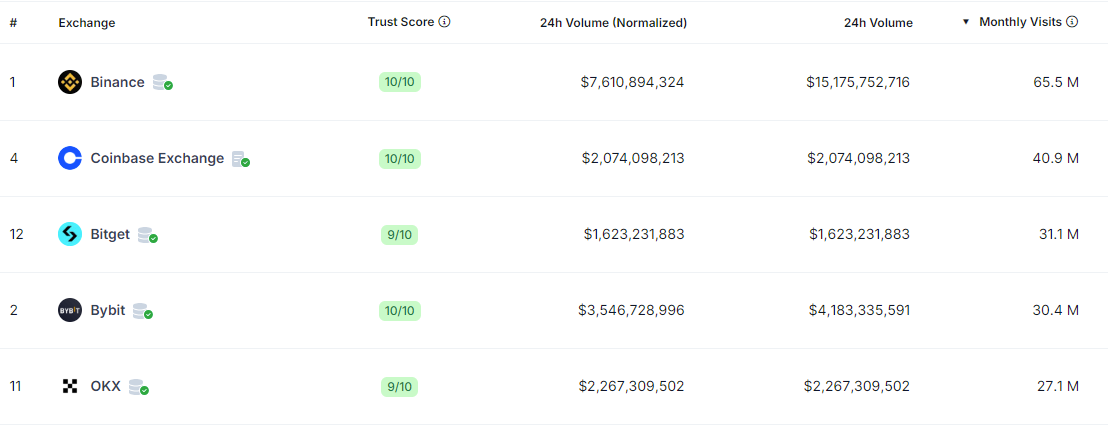
Market data from CoinGecko shows that Bitget and Bybit are among the top exchanges globally, ranking at #3 and #4, respectively, in terms of the number of visitors each has received in the last 30 days.
Bybit is particularly popular for derivatives trading and enjoys a significant user base in Japan. Despite their popularity, these platforms remain inaccessible to Japanese traders due to regulatory restrictions.
Comparing regulatory landscapes
Japan and the U.S. offer contrasting approaches to crypto regulation. Japan, under the Payment Services Act (PSA), recognizes cryptocurrencies as legal property.
However, crypto exchanges must register with the FSA and adhere to anti-money laundering (AML) and counter-financing of terrorism (CFT) guidelines.
Furthermore, in Japan, most cryptocurrencies are treated as assets, while initial coin offering (ICO) tokens are classified as type 2 securities, regulated under the Financial Instruments and Exchange Act (FIEA).
In contrast, the U.S. regulatory framework is more fragmented and evolving. In 2022, President Joe Biden’s administration took significant steps, initiating an executive order to evaluate the risks and benefits of cryptocurrencies, which led to a roadmap encouraging increased regulatory enforcement.
However, recently, the White House vetoed a bill from the House of Representatives that would have repealed a contentious bulletin from the U.S. Securities and Exchange Commission (SEC), which many lawmakers felt could be a major impediment to companies offering custodial services for crypto assets.
The SEC has been proactive, treating many cryptocurrencies as securities and pursuing legal action against non-compliant crypto businesses. A notable development was the 2023 court ruling that determined Ripple’s sale of XRP as securities only when sold to institutions, not on exchanges, which marked a nuanced win for the crypto sector.
Both Japan and the U.S. are actively refining their regulatory policies, with Japan leading a structured and clear-cut approach while the U.S. navigates through ongoing legal and regulatory debates.
Credit: Source link